DevOps: myths, real responsibilities, and the importance of culture in IT
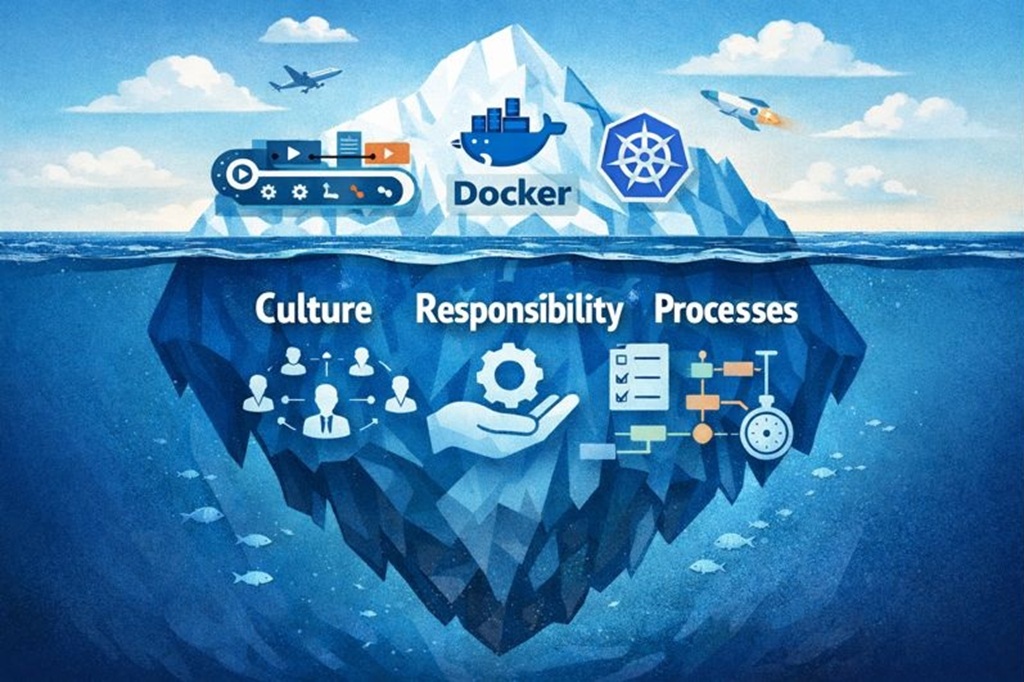
You have CI/CD Set up and think you’re doing DevOps? You’re wrong.
“DevOps” is about as common in the IT world today as “coffee.” Everyone wants it, everyone “does” it, and every job ad is hunting for a DevOps Engineer. But hand on heart—if someone says DevOps at your company, do you immediately picture just Jenkins, GitLab CI, Docker containers, and automated deployment?
If you nodded, we have to disappoint you. That is not DevOps.
It’s like buying the most expensive running shoes on the market and claiming you’re an Olympic athlete. The shoes (the tools) are great; they help you. But running (the process and the fitness) is something else entirely.
So, let’s clear up the terms and crush the myth that DevOps equals pipeline automation.
What DevOps definitely IS NOT
Let’s start with what we see most often. Many companies believe that once they automate build and deploy, they are done. But DevOps is not CI/CD. That is just a technical crutch. Similarly, DevOps is not tools. You can have the entire suite from Atlassian to Kubernetes, but if you don’t have the right culture, you just have expensive chaos.
Then there’s the next misconception: “We are DevOps, so we don’t manage or document; we just deliver fast.” Absolute nonsense. DevOps does not mean a lack of management. And it certainly doesn’t mean speed at the expense of quality or security. If you deploy 10 times a day but crash production 5 times, you aren’t doing DevOps. You’re just making mistakes very quickly.
And one final slap for those who think DevOps is “that team over there”: DevOps is not a phase after development, and it isn’t just infrastructure management. It’s not a step where developers toss code over the wall to the “DevOps guys” to deploy it.
What on earth is it, then?
If we stop viewing DevOps as a set of scripts, we find that it is an end-to-end delivery management model. It is a holistic view of how an idea transforms into value for the customer.
Here are the pillars of true DevOps that are often forgotten:
- Shared responsibility (Not “That’s Not My Problem”) DevOps means the entire team is responsible for the result. It doesn’t mean the developer does everything, but it means they care about how their code runs in production.
- Automation + Standards + Evidence Yes, automation is part of it. But its goal is to create small, safe, and reversible changes. Every step must be backed by evidence of quality. It is management based on rules and defined risks. (Read more in our blog: Automated test suite as a service ensuring stability for business critical systems)
- Observability and feedback You cannot improve what you cannot see. Real DevOps is built on data. It provides precise inputs that even allow you to measure the real cost of development.
A shock to finish: DevOps and Waterfall?
Finally, I have a little tidbit that might get agile purists out of their seats. DevOps is not about agile ceremonies. You don’t need Stand-ups or Retros to do DevOps. In fact, DevOps is compatible with Waterfall.
Why? Because DevOps is about the flow of work, feedback loops, the safety of changes, and the connection between business and IT. These are principles that work regardless of whether you plan in sprints or stages.
So, how are you doing?
Do you just have a “pipe” that dumps code onto servers, or do you have a process that manages quality, risks, and connects teams? Stop confusing plumbing (CI/CD) with the architecture of the house (DevOps). Tools are important, but without the right mindset, they are just toys.
Do DevOps properly. Not just automated, but managed. If you feel like you need a hand on your journey to full DevOps cycle we at CodeArt are ready to help.