Enterprise architecture: How to align business strategy with IT
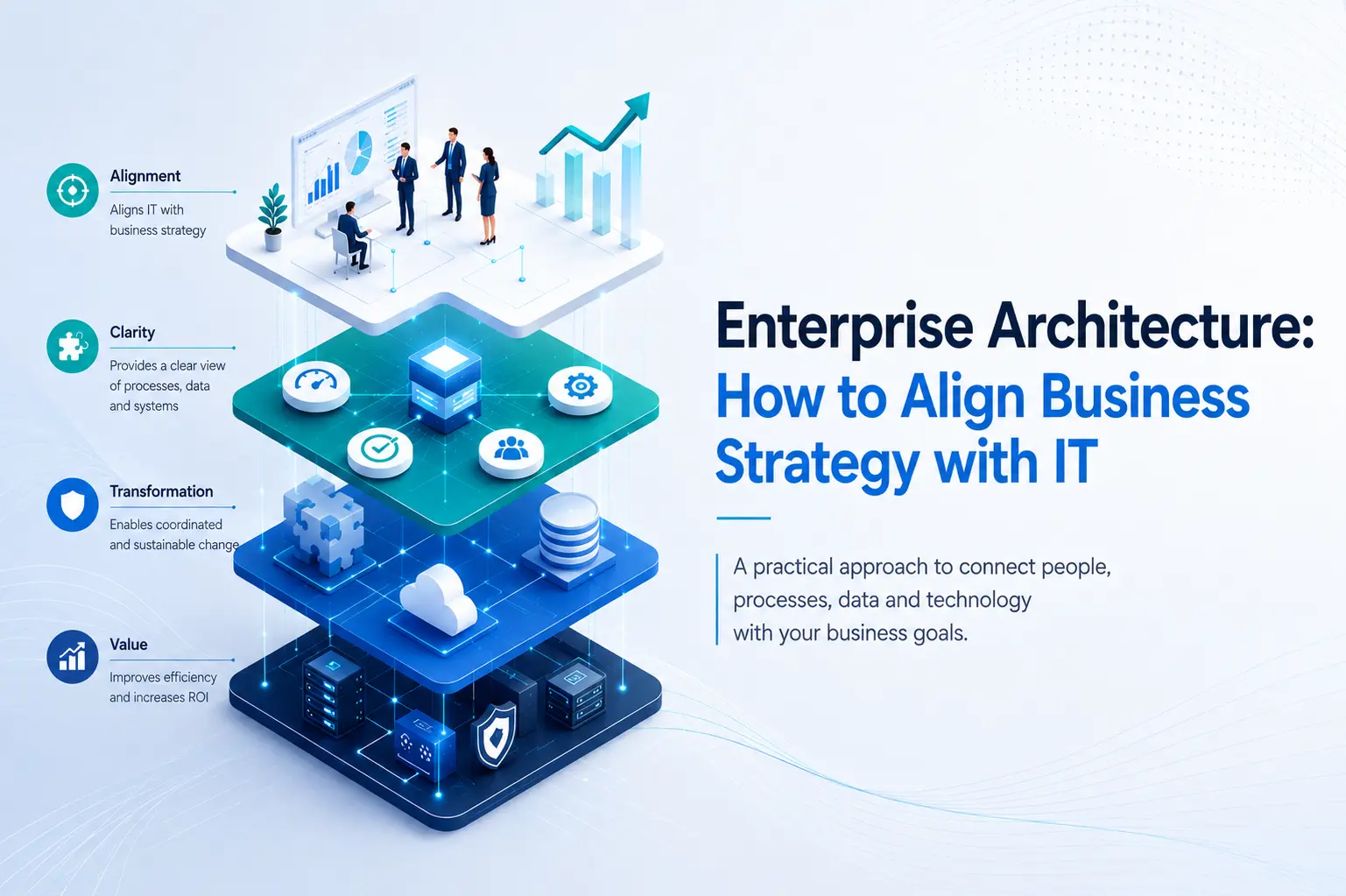
Most organisations today operate with a combination of systems, processes and solutions that were introduced gradually over time. Each of them may originally have addressed a specific need, but together they often create a complex environment with duplicated functionality, unclear dependencies and rising costs.
Enterprise Architecture helps organisations manage this complexity. It connects business objectives, processes, data, applications and technologies within one common framework.
What is Enterprise architecture?
Enterprise Architecture, commonly referred to as EA, describes:
- how the organisation operates today,
- what target state it wants to achieve,
- what changes are required to move from the current state to the target state.
It is not limited to the technical design of IT systems. EA helps organisations decide which processes and technologies should be developed, simplified or gradually replaced.
Its purpose is to ensure that individual projects and technology investments support the organisation’s overall business strategy.
When is Enterprise architecture most valuable?
Enterprise Architecture is particularly useful when an organisation is dealing with:
- digital transformation,
- rapid growth,
- the introduction or replacement of a key system,
- technology consolidation,
- integration following a merger or acquisition,
- increasing technical debt,
- high IT operating costs,
- complex dependencies between systems.
In these situations, change usually affects more than one system. It also influences processes, data, users, suppliers and other technologies.
Enterprise Architecture helps identify these dependencies before implementation begins.
What is the role of an Enterprise architect?
An Enterprise Architect connects the needs of management, business departments and IT teams.
Their role is to:
- map the organisation’s current state,
- identify problems, risks and dependencies,
- design the target architecture,
- compare possible solution options,
- prepare a realistic transformation roadmap,
- ensure that individual projects support a common objective.
An important part of the role is also explaining trade-offs. Not every requirement can be met without affecting costs, timelines or other parts of the organisation.
TOGAF as a proven framework
Enterprise Architecture can be developed and managed using the TOGAF® 10 Standard.
TOGAF provides a structured approach to analysing the current state, designing the target architecture, identifying the required changes and creating a transformation roadmap.
However, it is not a universal template that must be applied in the same way in every organisation. The approach can be adapted to the size of the company, the scope of the project and the specific business objectives.
Enterprise architecture as a practical management tool
The purpose of Enterprise Architecture is not to produce excessive documentation. Its true value lies in improving decision-making.
It helps organisations understand where they are heading, which changes should be prioritised and how those changes can be delivered with lower costs and risks.
When a company is dealing with growth, digitalisation, system modernisation or increasing technological complexity, Enterprise Architecture can provide a common and sustainable direction.
Certified expertise at CodeArt
CodeArt has a certified Enterprise Architect with knowledge and competencies based on the TOGAF® 10 standard.
This allows CodeArt to support clients not only in the development of a specific software solution, but also in placing that solution within the wider context of the organisation. For more information, please contact us at info@codeart.sk.