Technological debt is like a credit card. The question is: Who pays the interest?
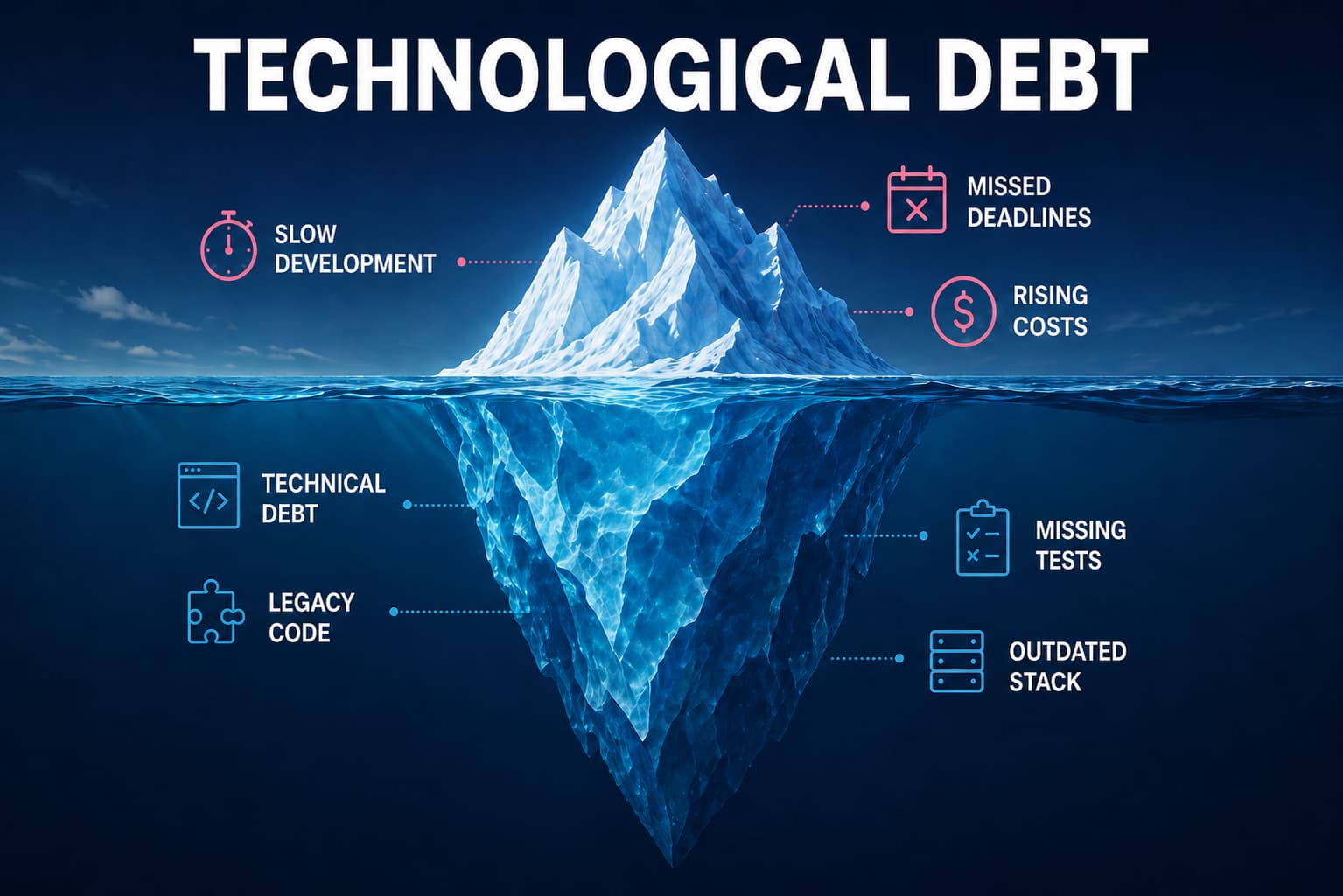
When small changes take months, you are not paying for development. You are paying off the past.
When you borrow time, you start paying off the future
Technological debt works exactly like a credit card. At a certain point, it helps you – it allows you to deliver a feature faster, respond to market pressure, or meet business expectations. In reality, however, you are not saving time. You are only borrowing it. And as with any loan, there is interest.
At first, it is almost invisible. Compromises in the code make sense, development continues, and nothing suggests there is a problem. Gradually, however, the first warning signs appear – small changes take longer, testing becomes more demanding, and the team is unsure about the impact of changes.
Then comes the breaking point. Even a simple change takes weeks or months. At that point, you are no longer developing a new product. You are only paying off decisions from the past.
Main causes
Tightly coupled architecture (spaghetti code)
In an ideal system, individual parts are separated. In reality, however, systems often emerge where everything is connected to everything else. A change in one place can cause a problem elsewhere. Developers are no longer creating solutions; they are analyzing impact. Every change requires understanding a large part of the system, which significantly slows development. Solution: gradual refactoring and decomposition into smaller, independent modules.
Lack of automated testing
Without tests, every change is a risk. The team cannot be sure that it will not break something. This leads to manual testing or to a level of caution that slows development even further. A vicious cycle emerges – fewer changes mean more system degradation.
Pressure to deliver quickly at the expense of quality
Technical debt often arises from business decisions. Refactoring is postponed to “later” – and later never comes. The interest grows and gradually slows down the entire development process. What was supposed to speed up delivery becomes its biggest obstacle.
Solution: treat quality as an investment and set aside time (for example, 20% of capacity) to reduce debt.
When technical debt starts running the business
Technical debt quickly has an impact beyond the IT department. What starts as a technical problem gradually becomes a team, financial, and strategic issue.
Impact on the team
Working with complex and unstable code leads to frustration. Developers want to create, not constantly fix old bugs. The result is burnout, loss of motivation, and the departure of experienced people. This makes the situation even worse.
Impact on the business
Slow development means slow time-to-market and a loss of competitiveness. At the same time, costs increase – experienced developers are solving problems that would not exist in a healthy system. The return on investment in IT declines.
Impact on the product
Complex systems produce more bugs, are harder to test, and often contain outdated technologies.
This increases the risk of outages and security issues. The team also starts postponing changes because each one feels too risky, and the product gradually stagnates.
How we approach technical debt at Codeart
Technical debt is a reality of every project. It cannot be eliminated completely, but it can be managed.
At Codeart, we approach it systematically and transparently. The client always knows where debt is created and what impact it has on speed and costs. Instead of large and risky rewrites, we prefer gradual refactoring that improves the system without endangering the business.
The foundation is architecture designed for change – modular, clear, and scalable. We consider automated testing and CI/CD to be a standard that allows changes to be made quickly and safely. (More in our blog: Your system works so why is everyone afraid to touch it?)
We do not see technical debt as something to be ignored. It is a factor that must be actively managed, measured, and communicated. Technical debt will always exist. The difference is whether you control it – or it controls you.