Your system works. So why is everyone afraid to touch it?
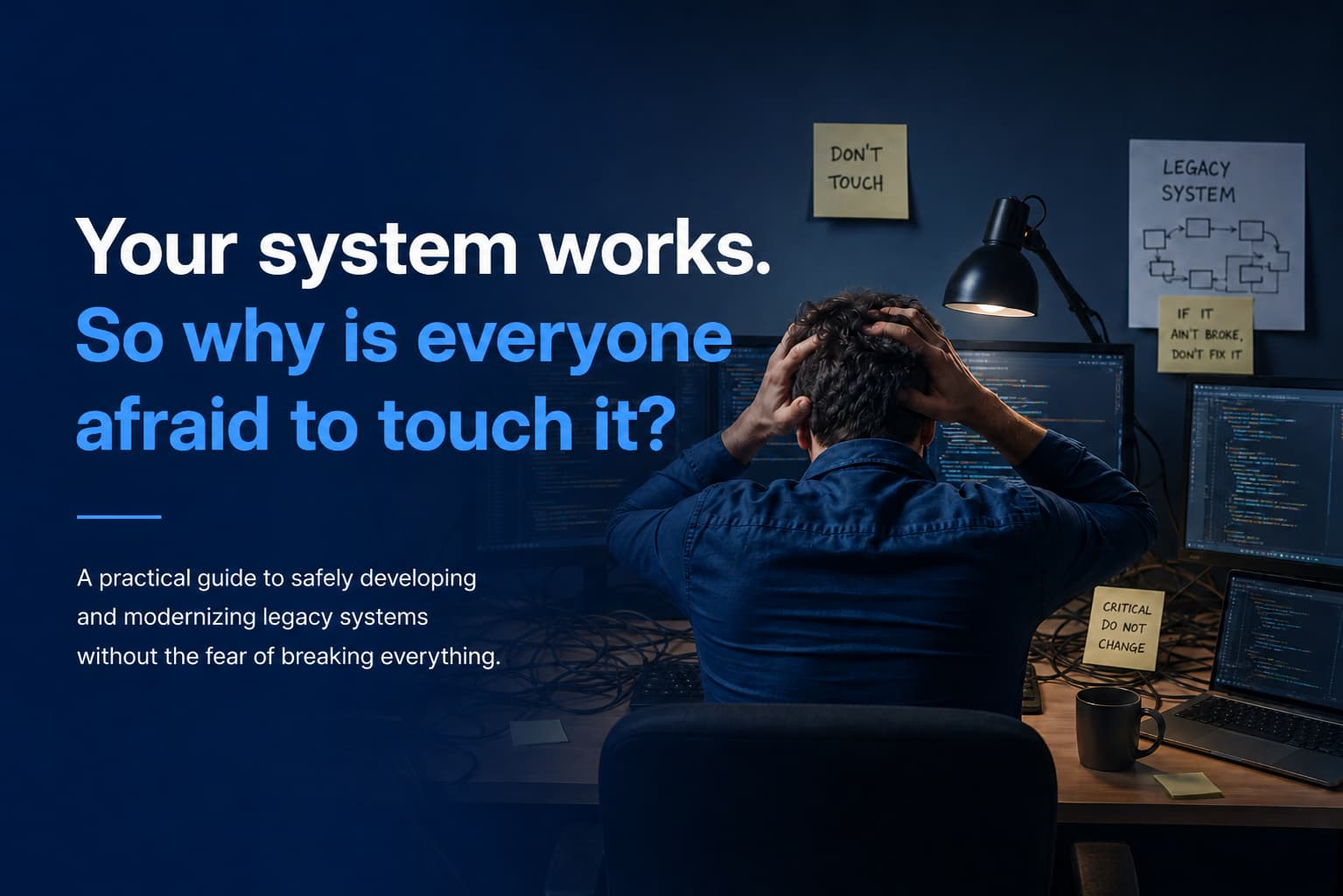
The system works, makes money, and keeps the company running. And yet no one wants to touch it. Not because it is bad, but because it is fragile. One change is enough – and something that worked for years stops working for no obvious reason.
“Honestly? We would rather not touch it. It works… but we are afraid the whole thing will fall apart.”
This is not an exception. This is the reality in many companies.
When development turns into risk management
In systems like these, it is no longer about how to build something. It is about how to change something without breaking everything. Why can this happen?
The system runs on an outdated technology foundation. Documentation is incomplete or out of date, and the original developers are gone. Every change takes disproportionately long – not because it is complex, but because its impact is unpredictable.
“When we change one thing, something else breaks. And no one knows exactly why.”
The result is stagnation. The system may still work, but the company starts adapting to it. (more in our blog: Technological debt is like a credit card. The question is? Who pays the interest.)
Why most attempts at change fail
The biggest mistake is surprisingly simple – development begins. Without understanding the system. Without controlling risk. Without safety mechanisms.
“It worked in the test environment… but it crashed in production.”
After a few experiences like this, trust in change disappears completely.
How to break this cycle
If a system is fragile, the goal is not to develop faster. The goal is to reduce the risk of every single change. How do you do that?
1.Understand first. Change later.
The first step is not programming, but understanding. The system needs to be analyzed, its dependencies mapped, and its riskiest areas identified. It is essential to create an exact copy of it, where all development and testing take place. This approach eliminates the greatest risk – that an error will affect the real business.
2. Safety nets before every change
Instead of trying to test everything, it makes more sense to protect what matters most. Key processes that directly affect customers and revenue are tested. No one can afford customers to be the first to notice a mistake. That is why a protective layer is created to catch problems before they reach production.
3. New things outside the old chaos
One of the biggest mistakes is expanding the chaos. That is why new functionality is not built directly inside legacy code, but separately. By separating new development from the old system, this risk is significantly reduced.
4. Stress-free deployment
Deployment must not be the risky moment. New versions are first verified in parallel, and only then is traffic switched over. That is why it is important for the old version of the system to remain available until the new one has been fully verified.
5. There is always a way back
Even with the best process, a problem can still appear. That is why every change must have a clearly defined rollback path – fast, controlled, and without business impact.
What changes in practice?
When this approach is applied consistently, the dynamics of the entire system change. Changes stop being stressful events and become a managed process. The system can be developed again without fear, and technical debt gradually decreases instead of growing.
The most important change, however, happens at the decision-making level. The company is no longer limited by fear of technology. It has control over it.
Conclusion
A legacy system is not the problem. The problem is when you lose control over it.
The good news is that control can be regained. Not through one big rewrite, but through a systematic approach that reduces risk, introduces predictability, and makes it possible to make changes without fear.
And that is when the system once again becomes what it is meant to be – a tool for growth.
How we can help you with this at Codeart
At Codeart, we do not see legacy systems as a problem that needs to be “rewritten.” We see them as critical assets that need to be stabilized, understood, and safely developed.
We help companies regain control over their systems – from the initial audit, through setting up a safe development and testing environment, to gradual modernization without outages or stress.
If you have a system you would rather not touch today, the problem is probably not the technology. It is that the system lacks a safe way to be changed.
And that is exactly where we begin.